

Monuments and Landmarks in Asia
1 2

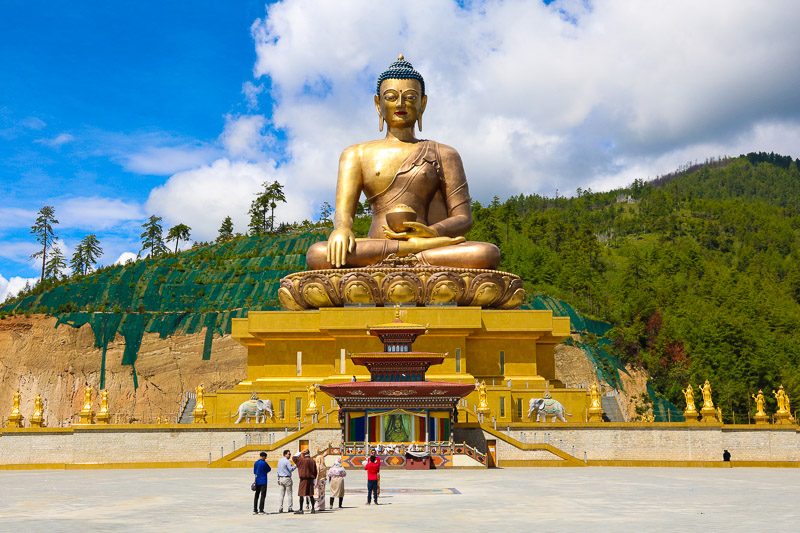
Donated by the Chinese and built by Thai, this 54 m tall buddha is some impressive sight. It's made in bronze, gilded in gold, and hold no less than 125,000 smaller Buddha statues. Though it's the tallest buddha statue in Bhutan, it is a dwarf compared to the world's tallest Buddha statue in China, which reach 128 m into the sky. The view from the base over Thimphu valley is almost equal impressive.
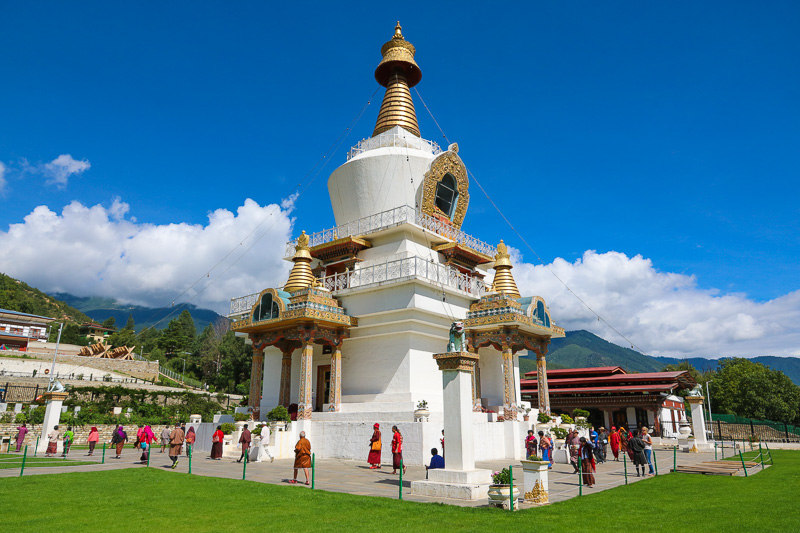
The queen mother built this stupa (chorten) in 1974 in memory of her son, the third king of Bhutan, who passed away two years earlier. It's a lovely sacred place favourite by many devoted buddhists, who circle the big prayer wheels and the big stupa. If possible, see the inside of the stupa too.
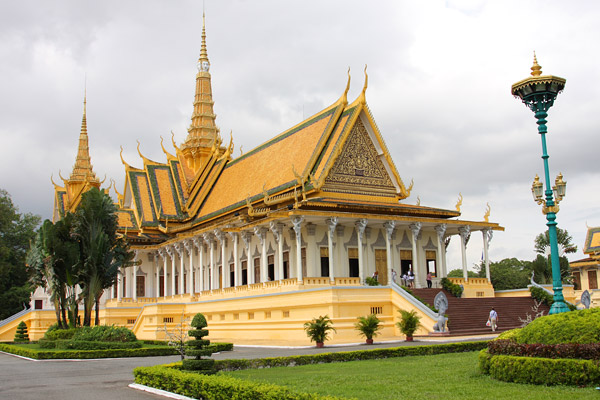
The Silver Pagoda is part of the Royal Palace. Its striking structure includes the bright yellow ornamented roof and a floor that is even more dazzling. Inlaid with more than 5000 silver tiles, each weighing 1 kg, it is very impressive - or would have been, if you could see it, for most of the floor is covered by a carpet, but you still get the idea at the entrance. Besides the silver floor, the pagoda also contains several important gem decorated Buddha statues. The grounds hold other marvelous buildings, like the French Pavilion (a gift from Napoleon III) which can not seem more out of place than here.
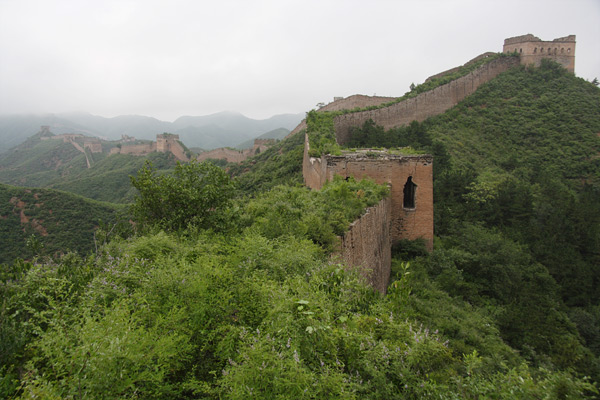
From Gubeikou pass, The Great Wall stretches in two directions, east (the so-called Wohushan Great Wall) and west (the so-called Panlongshan Great Wall). The Panlongshan Great Wall is an authentic wall section originally constructed in the 6th century by the Qi Dynasty, but hasn't been rebuilt since the Ming Dynasty (1368-1644). At first, it is just an overgrown and crumbled adobe construction which hardly can be recognized as a wall, but further on towards Jinshanling it will shape up and become a real wall in bricks with towers and steps.
You can trek along the wall from Gubeikou to Jinshanling (or opposite direction) which can be done within a day. The distance is 10 km and there are 56 towers in total. After the first 25 towers, the wall will become off limit for another 25 towers, due to military installation, and you need to detour through the corn fields below.
You can trek along the wall from Gubeikou to Jinshanling (or opposite direction) which can be done within a day. The distance is 10 km and there are 56 towers in total. After the first 25 towers, the wall will become off limit for another 25 towers, due to military installation, and you need to detour through the corn fields below.
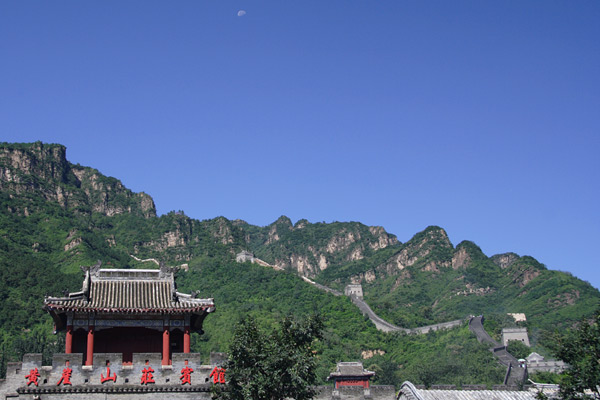
The Great Wall of China is not just one long piece, but several smaller parts dating back to different times. The Huangyaguan Great Wall was original built during the 6th century by the Qi Dynasty guarding against the northern tribes and was later reinforced by the Ming Dynasty (1368-1644). In 1984, 3 km of the wall went under serious renovation including 20 watch towers, a water pass, and a small castle with a maze which all appear brand new today. Due to the mountainous location, the Huangyaguan Great Wall snakes its way on the ridge from peak to peak, turning the steep sections into never-ending staircases.
This is where the annual Great Wall Marathon is held, a tough run even though some of the route is not actually on the wall.
This is where the annual Great Wall Marathon is held, a tough run even though some of the route is not actually on the wall.
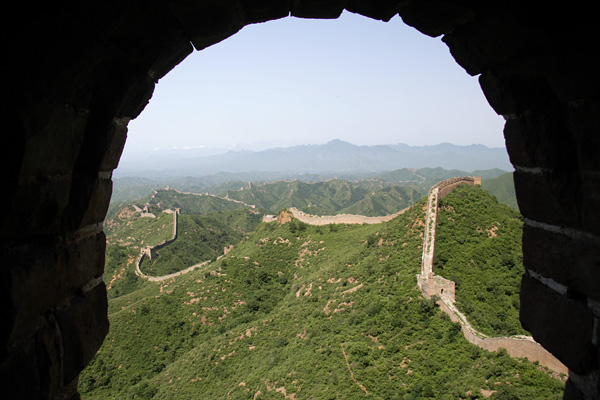
The wall at Jinshanling is probably one of the most exciting sections of the Great Wall of China. Near Jinshanling village, the wall has been renovated and is therefore very groomed, with cable car and outdoor loudspeakers playing Celine Dion. Going West towards Gubeikou, the wall quickly becomes naturally overgrown and decayed. Going East towards Simatai, the wall again becomes a bit deteriorated with loose surfaces but more winding with steep sections and plenty of stairs. This section offer great views of the snaking wall jumping from peak to peak until it disappears into the horizon, the image most people associate with the Great Wall of China.
You can walk on the wall all the way from Jinshanling to Simatai, a distance of 5 km, a trek that is quite popular these days.
You can walk on the wall all the way from Jinshanling to Simatai, a distance of 5 km, a trek that is quite popular these days.
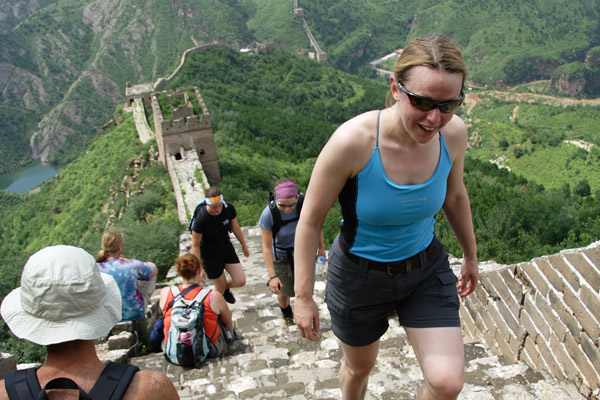
The Great Wall of Simatai shares history with the sections of Jinshaling and Goubeikou, since it is a part of the same defense of the strategic pass of Gubeikou further west. It connects with Jinshanling in the west through a challenging section that is rough and winding with loose bricks. Though the west section is steep at some points, it is nothing compared to the east section. Here, the wall clings to the mountain ridge at an angle up to 80 degrees (earning the name Heavenly Ladder), passes over a natural bridge limiting the width of the wall to only 50 cm (Sky Bridge) before it reaches the high Watching Beijing Tower (986 m), where it should be possible to see all the way to Beijing 120 km away on a clear night (clear sky, in China?). This last wall segment (including Heavenly Ladder and Sky Bridge) is unfortunately off limits due to the obvious danger, so it is not possible to test the claim, but the climb up to the forbidden part is still rewarding - and hard.
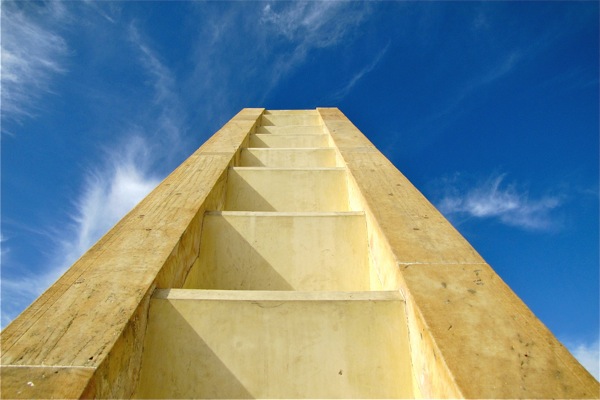
In Jaipur lies the vast astronomical observatory Jantar Mantar, which was built between 1727-1734 by Maharaja Jai Singh II. The area is one of Unesco's World Heritage Sites, and consists of 14 major geometric instrument made of marble, stone, and bronze. The instruments were used to measure time, predicting eclipses, measuring the distance to the planets and the like. Among others, it has the world's largest sundial, which is 27 meters high. It is impressive that these approx. 280 years old measuring instruments are still extremely precise - and sometimes are used to predict the weather by local astronomers.
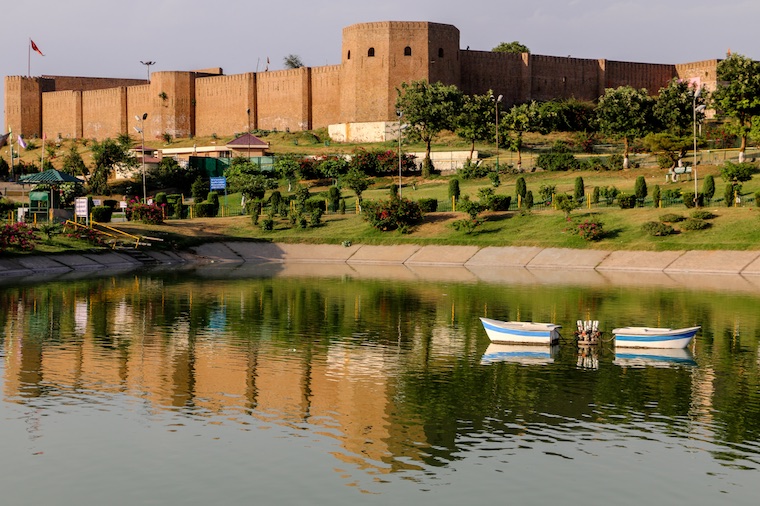
Sometimes locals really do know best. The city of Jammu in the north of India doesn't really get a lot of visitors. There are those that believe there isn't much to visit (wrong). If in town, and looking for what to do, just follow the locals to Bagh-e-Bahu park. The terraced park, on the banks of the Tawi River, makes for some excellent people watching. Whether ignoring the 'no picnic' signs or the 'no playing in the fountain' signs, the locals are fun. But far from being a one hit wonder, you can also check out monkeys diving into pools doing a twisted pike in a tuck position. The whole park is capped off with the Bahu Fort dating back 300+ years. People, primates and palisades, how could you go wrong?
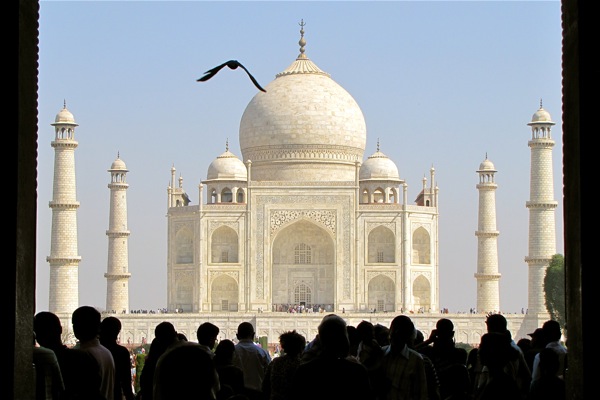
When you visit the Taj Mahal, it is obvious why the monument is on the list of The Seven Wonders of the World, and you'll be amazed at how large the old mausoleum actually is. It took approx. 22 years to build it, and it was completed in the year of 1653. The Taj Mahal was built by the Moghul Emperor Shah Jahan in honor of his third wife Mumtaz Mahal, who died giving birth to the couple's 14th child. Her coffin was placed in the middle of the monument, and when the Emperor died approx. 20 years later, his coffin was placed next to hers. So besides that it is a beautiful and impressive building, it also has a romantic history. There are always lots of tourists, but the area is so big that it does not spoil the experience.
1 2